

Supply Chain Management
Shih Wei regards every supplier as a long-term strategic partner and implements a comprehensive supplier evaluation system to co-create sustainable value. Criteria cover price, quality, and service and further integrate ESG dimensions. Since 2022, standards such as environmental compliance, occupational safety and health, and human rights protection have been incorporated. Related management measures were revised and implemented in 2023 to ensure suppliers' commitments and practices in sustainability.
To deepen sustainability, the HQ prioritizes products with eco-labels or energy-efficiency labels and actively practices local procurement and social impact purchasing (e.g., sourcing agricultural products from local smallholders to support the local economy and reduce transport-related carbon emissions). For fleet management, given industry characteristics, procurement/repair/contracting activities are often conducted in port where vessels call, with local suppliers as primary partners to lower the carbon footprint and foster local economic development. As of 2024, Taiwan local procurement accounted for 0.89% and overseas local procurement for 99.11%, demonstrating commitment to localization in global operations.
Overview of the Supply Chain in Marine Transportation
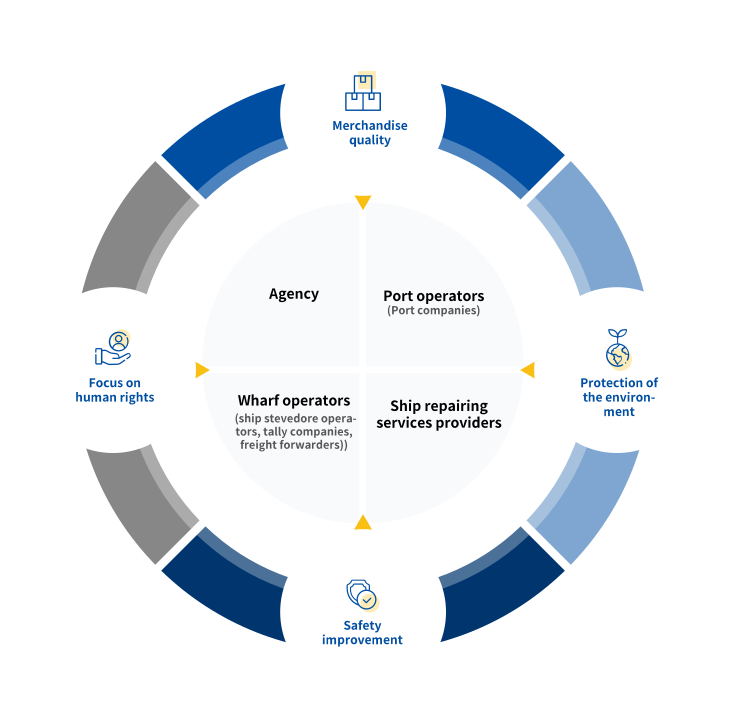
Shih Wei collaborates with hundreds of suppliers worldwide, including port agents, ports/ terminal operators, and shipyards as key partners. Through collaboration, we promote elevated standards in environmental protection, safety management, and hygiene across the supply chain. Suppliers are required to strictly comply with local laws and meet environmental, labor safety, health, and human rights standards. Responsibilities are also clarified via contract clauses or verbal communications to ensure fulfillment of sustainability obligations.
Operationally, we work closely with suppliers, service/repair providers, and classification societies to address real-time ship needs and ensure safe fleet operations, enhancing efficiency and strengthening supply-chain resilience and sustainability to underpin long-term ESG goals.
| Item | Content |
|---|---|
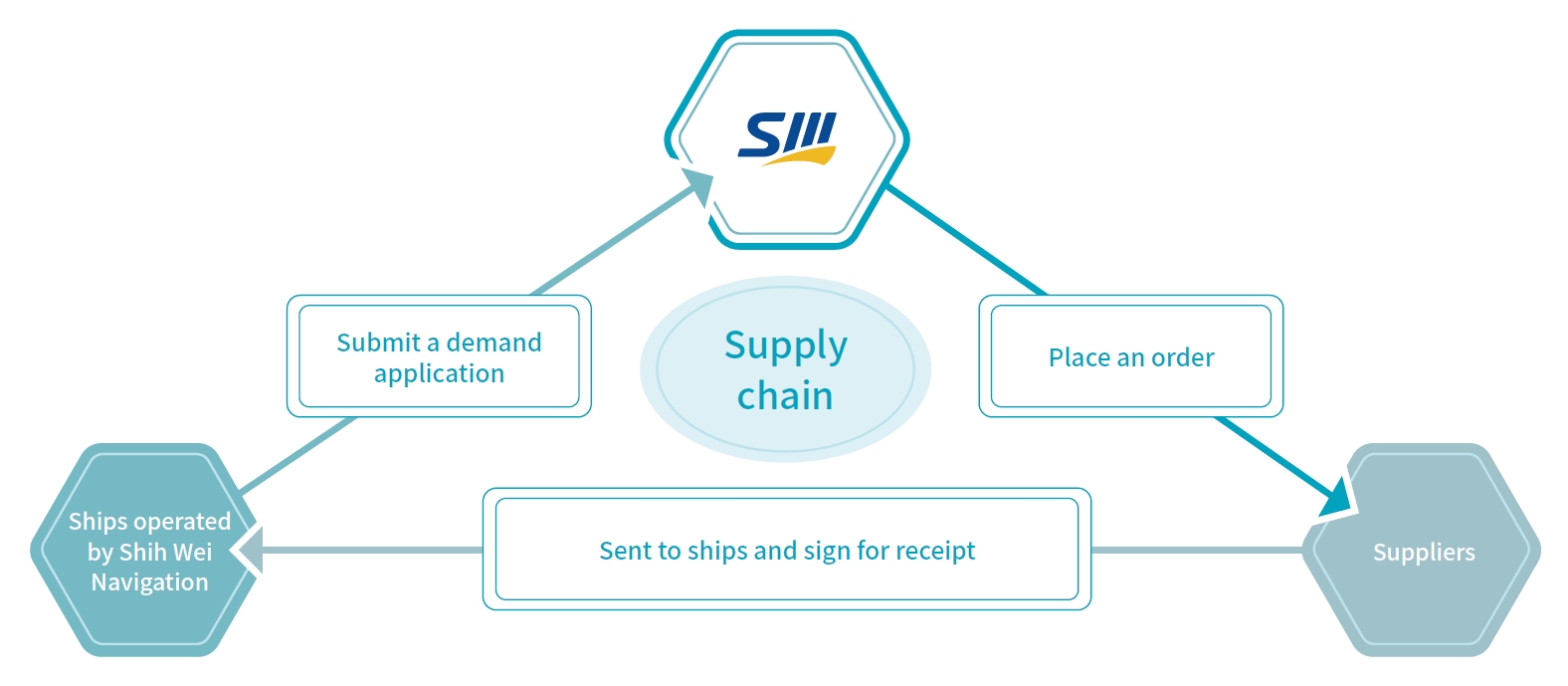
| Supply | The ship submits applications to the Company for demands for materials, accessories, nautical charts, various electronic devices, and so on, and the Company will then place orders and arrange delivery from the suppliers according to the appropriate port and look for suppliers with third-party verified MED (Marine Equipment Directive), ISO 14001, etc., and the delivery of materials is arranged by courier service providers. |
| Repair | When the ship reports for equipment damage that requires repair, the Company will first provide technical guidance for the ship end to repair by themselves. If the equipment cannot be repaired, it will be repaired by third-party certified (such as the classification society) repair service providers and technicians. After the repair project is completed, the surveyor assigned by the classification association will conduct the inspection and acceptance. |
| Ship Survey | To maintain the seaworthiness of the ships, the Company makes regular arrangement for relevant inspections (annual inspections), intermediate inspections (docking repair), and special inspection (docking repair), and the repairer/service providers and the classification association are entrusted to board the ship to jointly carry out the inspection items. |

We practice - Born by the sea, Love for the sea, Protecting the oceans, Loving the Earth
-
We adhere to the localization principle of the supply chain. By reducing transportation costs and carbon emissions, we can also decrease the overall carbon footprint of the supply chain and contribute to local employment opportunities.
-
When selecting suppliers, we prioritize environmental criteria, including the absence of asbestos and the availability of Material Safety Data Sheets (MSDS) for specific products, which are considerations for environmentally-friendly materials.
We believe in and protect - a friendly and safe workplace
-
The marine supplies are all verified to be in line with international regulations to maintain safety of navigation and safety of crew members
-
We require our suppliers to declare that they will comply with relevant regulations of the Company in terms of environmental protection, occupational health and safety and labor rights. Please refer Human Rights Policy page.

Suppliers Management System
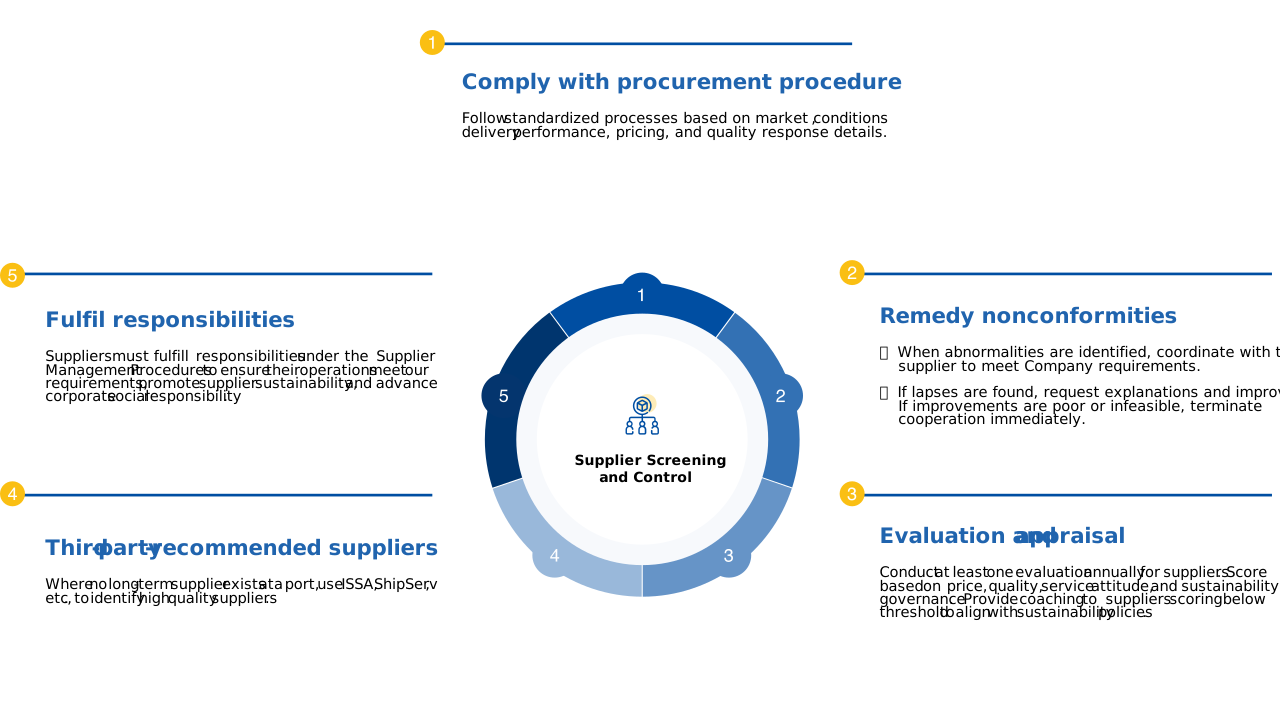
Shih Wei has established the “Supplier Management Policy” and “Supplier Management Procedures” to govern suppliers' capability and quality requirements, and maintains a “Supplier Directory”. At least once a year, performance is evaluated against price, quality, service attitude, and sustainability governance. Where needed, credit checks or bank guarantees are used to mitigate supplier-operation risks. Ongoing assessment and improvement are conducted through routine contacts and ad hoc mutual visits.
We reference the ISSA (International Ship suppliers & Services Association) member list to identify high quality suppliers. ISSA registered suppliers must follow its Code of Ethics, prohibiting predatory pricing, collusion/monopoly, slander of competitors, exaggerated claims, or poaching, to ensure safe delivery and reliable transactions, and are required to provide compliant product information (e.g., asbestos-free certificates) with each shipment.
As a global shipping company, Shih Wei requires suppliers to comply with Company policies and local regulations via contract-specified responsibilities, including the Human Rights Policy and Sustainability Commitment (See Human Rights Management ).We work with suppliers to enhance sustainability, maintain service quality, and fulfill corporate social responsibility.
Supplier Evaluation
New-Supplier Screening |
For fleet procurement, environmental standards are included in screening. Priority is given to:
Since 2023, the Human Rights Policy URL is included in the order system and email signatures (see 4.2 Human Right Management) to improve accessibility; continued advocacy encourages value chain partners to jointly respect human rights. In 2024, three new suppliers were added, all of whom recognized and signed Shih Wei’s Human Rights provisions, agreeing to comply during cooperation.
|
Existing-Supplier Evaluation |
Procurement follows procedures that consider market conditions, delivery performance, pricing, and quality responsiveness. The supplier management system verifies environmental and social performance; partners complying with international regulations and holding certifications are prioritized.
In 2024, the Marine Department conducted annual evaluations for long-term suppliers across five dimensions: price, quality, service enthusiasm, environment, and human rights. Where deliveries did not meet specifications, the Company promptly coordinated for improvement or replacement/return. Where supply/control lapses were found, explanations and improvement plans were requested. If improvements failed to meet expectations or requirements, cooperation would be terminated. All 102 suppliers evaluated passed. No terminations due to environmental or social negative impacts occurred, indicating effective implementation and no significant adverse impacts. |
Quality Control of Suppliers