Sustainable Development Vision and Strategy
In the face of the global trend of net zero emissions, Shih Wei Navigation, as a global citizen, has gradually promoted the formulation of sustainable policies, systems, and related management approaches and guidelines for the enterprise to achieve sustainable development.
Sustainable Management Framework
Shih Wei administration Department serves as the coordinating unit for sustainability-related affairs. Under the Sustainable Development Committee, cross-functional working groups are established, including the Sustainability Information Disclosure Task Force, the GHG Inventory Task Force, and the Corporate Social Impact Team, with the President acting as convener. These groups oversee environmental, social, and governance (ESG) topics, advance sustainability projects, manage disclosures, and support external ESG evaluations. The Committee reports to the Board at least annually to ensure effective oversight.
After the annual Sustainability Report is finalized, the implementation results and future plans are reported to the board of directors on a regular basis, at least once a year. In terms of GHG inventory, relevant planning and implementation status are also reported to the board of directors on a quarterly basis to fulfill the supervisory responsibility.
The implementation status of the Company's sustainable development was reported to the board of directors in the meeting dated August 12, 2025.
The implementation status of the Company's sustainable development was reported to the board of directors in the meeting dated August 13, 2024.
The implementation status of the Company's sustainable development was reported to the board of directors in the meeting dated July 11, 2023.
The board of directors regularly receives reports from the management team, discussing strategic issues, including ESG, and key significant events. They assess the impacts on the economy, environment, and society, and supervise the management team for adjustments when necessary. Responsibility units for each agenda item will provide follow-up reports at the next board meeting. In the fiscal year 2024, the company submitted ESG-related proposals to the board of directors; for details, please refer to 5.1 Governance Structure of the sustainability report.
Sustainability Visions and SDGs
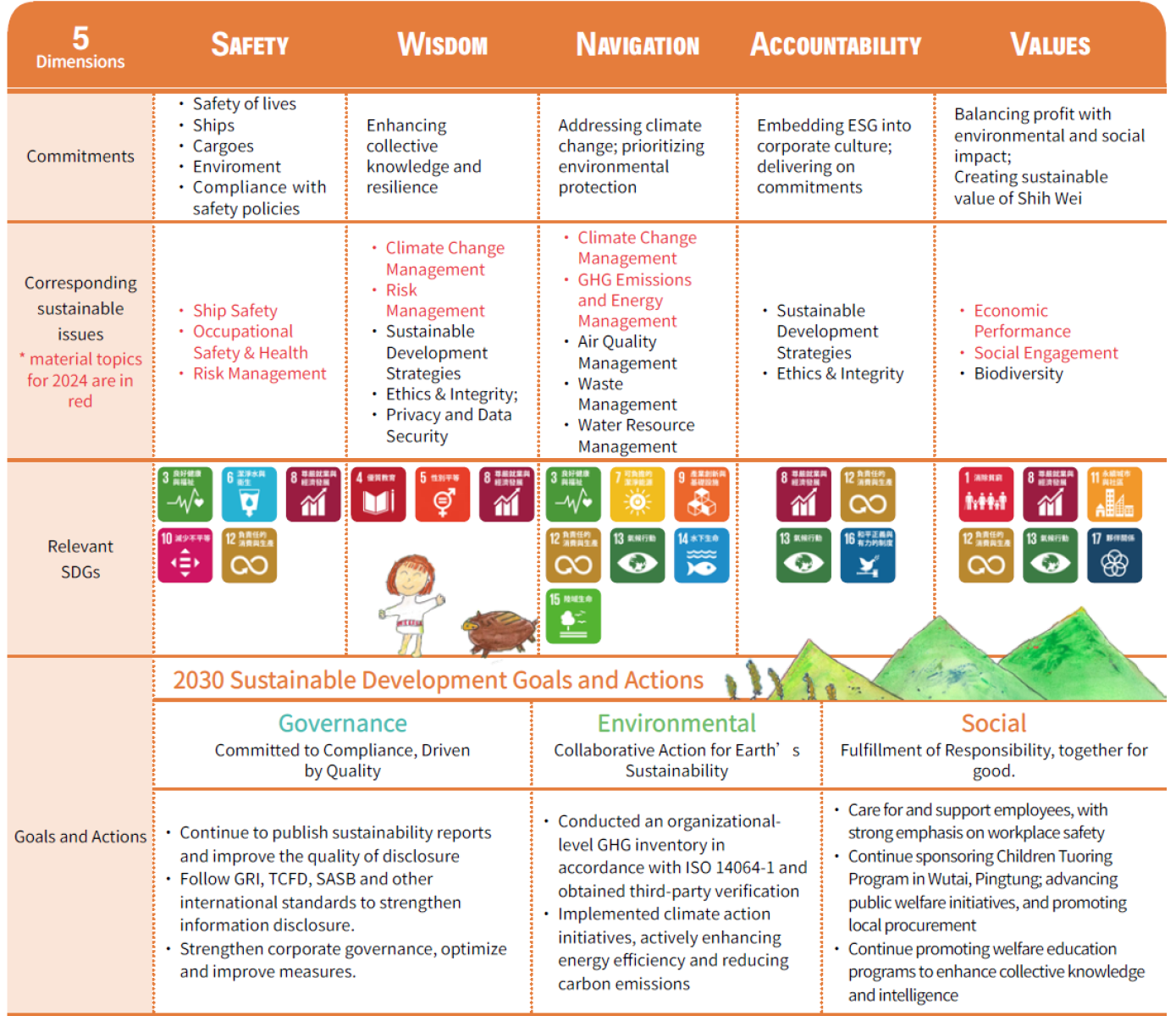
In the context of rising awareness of sustainability and constantly increasing climate risks, the promotion of net-zero transition has become a crucial issue critical to the survival of an enterprise. In 2024, Shih Wei Navigation integrated the UN SDGs, the 2030 Sustainability Vision Blueprint establishes ESG goals and action strategies based on five dimensions, adjusted in response to global trends, to drive continuous sustainability progress.
Specific Actions
Shih Wei Navigation, following the GRI Universal Standards 2021: GRI 3: Material Topics 2021 and the EU's Double Materiality principle, assessed the actual or potential impact of the company's economic activities on the external economy, environment, and people (human rights). This evaluation, aligned with the Double Materiality principle, enhances stakeholders' and information users' understanding of the significant impact Shih Wei Navigation has both externally and internally during its economic activities.
In terms of risk management, the company referred to the recommendations of the Task Force on Climate-Related Financial Disclosures (TCFD) by the Financial Stability Board (FSB), constructing five major risk dimensions and identifying 26 risk issues. Strategies were formulated to address high-risk areas.
For more details, please refer to the following webpage:
We disclose the specific actions and implementation status of sustainable development at Shih Wei Navigation's main locations from January 1, 2024, to December 31, 2024. The reporting boundary of this report covers the Company's headquarters (hereinafter referred to as HQ) and its subsidiaries with respect to the governance and social aspects. The environmental aspect mainly focuses on the fleet operation-related data of the HQ and its subsidiaries (excluding Dancewoods Hotels & Resorts.), as detailed in the table below:
In terms of Environmental
| Material Topics |
Risk Assessment Items |
Specific Actions |
| GHG Emissions and Energy |
- Environmental risk
- Regulatory Compliance
|
- Commissioned the Taiwan Energy-Saving Patrol to review electricity usage and provide recommendations. Since February 2024, adopted hybrid vehicles for official use and piloted a rotating schedule for chiller systems to save energy.
- Adopted low-sulfur fuel and silicone-based antifouling or high-performance paints; implemented speed reduction while entering ports to improve air quality; replaced onboard lighting with LED systems (one vessel upgraded in 2024); sold 3 old ships and delivered 1 new Eco ship. Some were equipped with Engine Power Limitation (EPL) devices to meet EEXI requirements, and new vessel designs incorporate closed-loop water piping systems.
- Achieved qualification for carbon quota trading and management under the EU ETS. Digitally manage and report annual fleet carbon emissions within EU waters, submit EU Allowances (EUA), and assess the use of biofuels to further reduce emissions.
- Integrated weather forecasting with software-based CII monitoring to reduce fuel consumption.
|
| Climate Change Management |
In terms of Social
| Material Topics |
Risk Assessment Items |
Specific Actions |
| Occupational Safety and Health |
- Business continuity & incident/crisis handling
- Regulatory Compliance
|
- Establish a Human Rights Policy and promote it to suppliers; conduct fire drills and health-promotion training; provide reflective thermal vests, workwear, and helmets to personnel visiting ships; offer flexible telework arrangements based on job requirements; and implement health checks exceeding legal requirements.
- Conduct ad hoc safety and health trainings and share real cases; investigate incident causes and formulate preventive measures; monitor weather and sea conditions to issue alerts and assist ships in choosing optimal and safe routes; supervise high-risk operations and ensure use of protective equipment; urge labor service companies to strengthen pre-employment training; and, in the event of casualties, assist the individual or family with proper insurance handling.
- Plan to introduce electronic SMS documentation and complete cloud HR system deployment to improve management efficiency and facilitate crew access to rules.
|
| Social Engagement |
Although not included in the Company's top ten risks, we have performed assessments specifically targeting local community risks and corporate reputational risks. |
- Held 2 coastal cleanups; created 1 marine-debris mural; promoted marine and environmental education.
- Sponsored the After School Association's Wutai base in Pingtung for 3 consecutive years; donated fruit, dictionaries, and 82 sets of the board game “Be a Sea Turtle”; hosted the 2024 Little Picassos Painting Contest; provided learning resources for aboriginal children.
- Donated ASUS “Refurbished Computer – Hope Project”; donated second-hand warm clothing to an animal protection association; donated second-hand goods to Hualien 5 way house and Wanhua Dashuigou 2nd hand shop to advance the circular economy.
- Organized an in-house table hockey game and gift-box charity sales and donated the proceeds; employees sponsored the Dream Gift Program; employees could exchange blood donations for extra leave; purchased small farmer honey date gift boxes and Mikania micrantha (mile-a-minute weed) product sets for holiday gifting; purchased vouchers via “Buy Directly from Farmers” to support the local economy and employee well-being.
|
In Terms of Governance
| Material Topics |
Risk Assessment Items |
Specific Actions |
| Economic Performance |
- Working capital and liquidity
- Asset acquisition and disposal
|
- Introduced systematic management of vessel operations and maintenance to reduce costs while maintaining service quality.
- Prioritized high-yield contracts in chartering decisions, reduced debt ratios, and increased financing.
- Deployed low-carbon vessels to secure premium charter rates and accelerated fleet renewal.
- In case of adverse events, relevant departments analyze root causes, implement countermeasures, and establish preventive actions to minimize losses and avoid recurrence
|
| Ship Safety |
- Regulatory Compliance
- Ship inspection and rating
|
- Equipment management: Regular replacement of steel wires , mooring ropes, and thimble spelter sockets (pi-pa heads) to prevent degradation risks.
- Personnel training: Ballast water system and COLREGs (International Regulations for Preventing Collisions at Sea) training for both seafarers and shore staff to enhance operational capability and reduce errors.
- Accident response: After an incident, notify insurers and port authorities for investigation. Follow SMS, Flag State, Class, and P&I Club guidance for remediation, and complete permanent repairs promptly.
- Preventive measures: Hold monthly cross-department meetings to review events; issue case circulars fleetwide. Intensify advocacy of the International Regulations for Preventing Collisions at Sea.
- Monitoring and support: Port Captains ride along to observe operations, provide advice and training. The Company conducts ad hoc ship visits for supplemental inspections.
|
| Risk Management |
All of Risk Assessment Items |
- Fleet renewal: dispose older vessels and acquire eco ships.
- Regulator y response: Obtain qualification to trade/manage EU ETS allowances and duly surrender EUAs; assess biofuel use to reduce carbon emissions.
- Personnel training: Strengthen crew skills for low-carbon fuels and equipment operation.
- Equipment support : Provide antifreeze and other supplies to prevent fuel freezing during cold snaps.
- Incident analysis: Analyze root causes of actual incidents and PSC deficiencies. Notify the fleet to prevent recurrence.
- Organizational operation: Establish a Risk Management Task Force to study risk trends and countermeasures on a regular basis.
|
For more details, please refer to our company's sustainability report.