

Climate Governance
The issues of climate change have continued internationally for years. In 2022, Taiwan officially announced Taiwan’s Pathway to Net Zero Emissions in 2050. To respond to the government policy and effectively mitigate the impact of climate change, Shih Wei Navigation has set GHG emission targets based on the international maritime climate change strategies initiated by IMO and incorporated the SDGs into its operating activities. Shih Wei is committed to Net-Zero by 2050 with management strategies and monitoring the management performance regularly. Based on the IMO’s GHG reduction strategy, we set medium- to long-term emission targets and will adjust strategies dynamically in line with global trends and emerging technologies.
The Board of Directors is the highest governance body overseeing sustainability, with direct supervision by the Chair. Shih Wei has established a cross-departmental Risk Management Team and a GHG Inventory Task Force to manage operational risks (including climate change) and GHG inventories. TCFD results are approved by the Chair and reported to the Board before the publication of the Sustainability Report to ensure effective oversight. Climate related risk management and GHG reduction progress are
reported to the Board quarterly, and TCFD content is updated annually to align with operations and stakeholder needs.
| Year | 2030 | 2040 | 2050 |
|---|---|---|---|
| Description | Short-term Target | Medium-term Target | Long-term Target |
| Target | 20% reduction vs. base year | 70% reduction vs. base year | Net-Zero |
| Strategies and Measures |
|
|
Seek cost-effective green alternative energy. |
Notes:
1. Our company implemented the ISO 14064-1:2018 Organizational GHG Inventory in 2023, updating the current year as the new base year.
2. Starting from the baseline year, reduce emissions by at least 2.9% annually to achieve a 20% reduction by 2030.
Research and Development Investment
Shih Wei Navigation has maintained a long-term investment in Thermolysis Co., Ltd., focusing on carbon fiber recycling and reclamation technology. This initiative realizes resource circularity to reduce overall energy consumption.
Clean and Green Energy
We actively promote the application of biofuels. In addition to encouraging clients to adopt low-load renewable energy sources through contractual incentives, we conduct technical and safety training for crew members on biofuel usage across various main engine brands. In 2025, the completion rate for this training reached 100%
Climate Risk Management
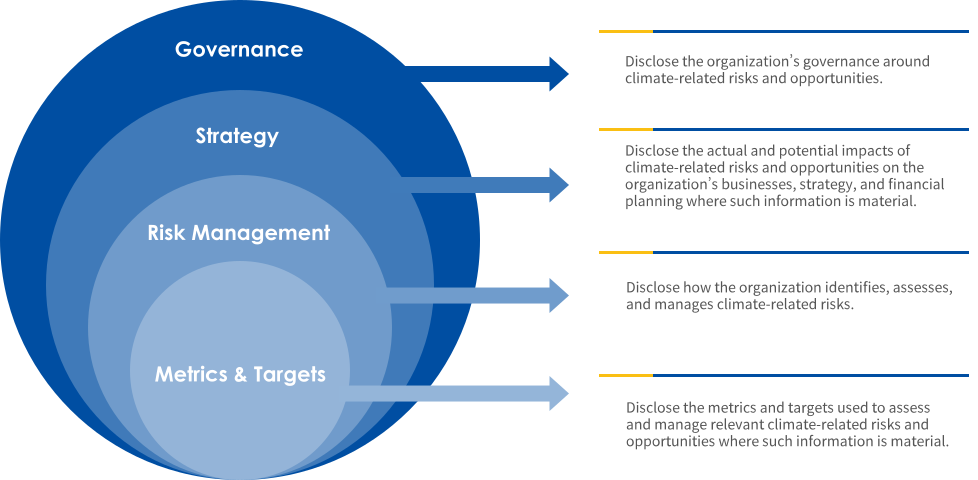
With the EU Emissions Trading System (EU ETS) expanding to the maritime industry in 2024, and the IMO’s revised decarbonization strategy (2023), Shih Wei has adopted the Task Force on Climate-related Financial Disclosures (TCFD) framework to systematically analyze risks and opportunities associated with climate change. Guided by the four TCFD pillars - Governance, Strategy, Risk Management, and Metrics & Targets - the Company systemically analyze potential climate-related risks and opportunities, formulate climate strategies, identify physical and transition risks, adopt carbon reduction technologies and transition to low-carbon fuels, and set specific emission reduction targets to mitigate financial impacts, strengthen operational resilience, and capture low-carbon market opportunities.
Climate Risk and Opportunities & Responses
We actively formulate solutions to mitigate the operational and financial impacts of climate change and to enhance resilience. For high-risk climate factors, response measures are planned, and financial impacts are evaluated to strengthen preparedness.
| Climate Risk and Opportunities | Content | Countermeasures | Future Opportunities |
|---|---|---|---|
Transition RisksPolicy and Legal |
|
Short-term: Accelerate fleet renewal and progressively apply silicone-based antifouling or high-performance coatings to maintain a younger, eco-efficient fleet; continuously track R&D trends in alternative green energy and emerging technologies to reduce exposure to carbon taxes/fees. Medium-term: Construct Eco new buildings; expand low-carbon service; retrofit vessel equipment; schedule hull cleaning to achieve carbon reduction effects; adopt biofuels; and continue building a technical performance database to monitor the effectiveness of each technology. Long-term: Adopt green energy and improve equipment efficiency. |
Successful green transition will reduce carbon costs and enhance competitiveness. |
Transition RisksMarket Opportunities |
|||
Transition RisksTechnology and Innovation |
|
|
A successful green transition will help drive business growth and strengthen corporate resilience. |
Physical RisksAcute |
Increase in extreme Weather events |
|
Flexible and stable route planning enhances vessel resilience, reduces operational risk, and increases customer utilization. |
For more details, please refer to our company’s sustainability report.
Impact of Climate Change on Operations
The global maritime industry emits approximately 1 billion metric tons of GHG annually, accounting for about 3% of total global emissions, which significantly impacts the environment If no active actions are taken, in addition to the negative impact on the environment, we may also be forced to face the situations in which the investors, customers and other stakeholders will gradually increase their demands for low-carbon ships and the government may impose stricter laws and regulations so that the ships may be required to slow down or be levied carbon taxes or carbon fees. Proactive countermeasures have to be proposed to avoid negative impact on corporate profitability. Looking at this from another perspective, new market opportunities can be created by ensuring the advantages of environmental performance. Shih Wei Navigation will strive to work on its environmental performance so as to become the most preferable bulk shipping company with sustainability development.
Energy Management Certification and Regulatory Compliance
Shih Wei Navigation has established an Energy Management Policy (EMP) and prepares the Ship Energy Efficiency Management Plan (SEEMP Part II & III) in accordance with the mandatory regulations of MARPOL Annex VI and IMO Resolution MEPC.213(63). The plan is executed by the SEEMP task force to manage fuel consumption and reduce GHG emissions from vessel operations. The SEEMP Part II and Part III for the entire fleet have been strictly audited by ClassNK, a third-party verification body, and have obtained the "Confirmation of Compliance (CoC)." All shore based and seafaring personnel are required to follow the Company’s EMP when implementing SEEMP. Records, monitoring/analysis, and improvement actions are consolidated to lay the groundwork for the next iteration of improvement. Through SEEMP, both the Company and its vessels operate an energy-efficiency PDCA cycle (Planning, Doing, Checking, Assessment) for continual improvement.
Marine fuel is the fleet’s primary energy source. To comply with the IMO 2020 global sulphur cap, the fleet uses 0.5% LSFO worldwide; ≤ 0.1% sulphur fuel in Emission Control Areas (ECAs); and ≤ 0.1% sulphur distillate (MGO/MDO) within 24 nautical miles off the California coastline. These measures reduce SOx at source, help lower air pollution, and improve the Air Quality Index (AQI).
The fleet strictly complies with international environmental conventions and applicable regional environmental regulations, and implements operational controls and decarbonization strategies to reduce energy consumption— delivering safe, high-quality transportation services while contributing to marine ecology and planetary health. At the HQ, Shih Wei promotes green procurement, purchasing energy-efficient, power-saving certified products to reduce electricity use.
- The Fleet: Fuel oil (main engines, generators, auxiliaries)
- Head Office: Purchased electricity

| Item | 2022 | 2023 | 2024 |
|---|---|---|---|
| Diesel (metric tons) | 9,019 | 7,766 | 7,596 |
| Heavy oil (metric tons) | 111,071 | 106,962 | 94,583 |
| Total (metric tons) | 120,090 | 114,728 | 102,179 |
| Diesel (GJ) | 368,579.263 | 317,372.941 | 319,368.768 |
| HFO (GJ) | 4,746,087.462 | 4,566,272.546 | 4,034,523.470 |
| Total fuel consumption (GJ) | 5,114,666.462 | 4,566,282.546 | 4,353,892.238 |
| Ton-Nautical Mile (t-nm) | 395,132,066,870 | 398,541,712,578 | 385,525,733,199.091 |
| Energy intensity (GJ/ t-nm) | 0.0000129442 | 0.0000122538 | 0.0000112934 |
| Item | 2022 | 2023 | 2024 |
|---|---|---|---|
| Purchased electricity | 184,952.190 | 174,471.223 | 176,539.340 |
| Purchased electricity- Shore power for passenger ship (kWh) | N/A | 5,680.000 | 19,495.000 |
| Total electricity consumption (GJ) | 665.828 | 648.480 | 705.724 |
| Employees | 74 | 74 | 74 |
| Energy intensity (GJ/ employees) | 8.998 | 8.763 | 9.537 |
Notes:
- The Company currently does not use renewable energy.
- HQ electricity includes exclusive (tenant) use and common-area use. Exclusive use is based on monthly utility bills (kWh) and allocated by each year’s date range; common-area use is prorated by the office’s share of the building’s gross floor area (GFA). Fleet energy use is derived from Class NK fuel consumption verifications and heating-value factors: for 2022–2023, diesel 8,400 kcal/L and HFO 9,600 kcal/L; from 2024 onward, annual average calorific values published by the Taiwan Ministry of Environment are applied. Unit conversions follow the official table: 1 kWh = 3.6×10 ⁶ J; 1 Gcal = 4.184 GJ.
- From 2023, the parent company’s energy statistics include the passenger ship Dancewood No. 1; in 2022 the vessel was lay-up therefore no data are available.
- To ensure year-on-year comparability, historical figures have been recompiled (restated) using the revised calculation methodology above.
GHG Management
To strengthen GHG control and disclosure, Shih Wei completed self-inventories for 2019 ~ 2024 for parent company and its subsidiaries (HQ and Fleet) and formally adopted ISO 14064-1:2018 in 2023, defining organizational boundaries under operational control.
The GHG emission data for 2023 and 2024 has obtained a Greenhouse Gas Verification Opinion Statement issued by the CR Classification Society. We received a reasonable assurance level for Scope 1 and Scope 2, and a limited assurance level for other indirect GHG emissions. Execution progress has been reported to the Board quarterly since 2022. Comparing 2023 vs. 2024, the total emissions decreased by 10.14%.
Unit: tonCO2
| Item | 2022 | 2023 | 2024 | |
|---|---|---|---|---|
| Scope 1 | 380,858.759 | 14,453.081 | 16,638.167 | |
| Scope 2 | 93.590 | 118.669 | 193.822 | |
| Scope 3 | N/A | 361,015.852 | 320,662.186 | |
| Total | 380,952.346 | 375,587.602 | 337,494.175 | |
| Revenue (NT$ million) | 6,716 | 3,461 | 3,493 | |
| Ton-nautical Mile | 395,132,066,870 | 398,541,712,578 | 385,525,733,199 | |
| Intensity (metric tons CO2e/NT$ million) | 56.725 | 108.5199 | 96.6201 | |
| Intensity (metric tons CO2e/ Ton-nautical Mile) | 0.000000964 | 0.000000903 | 0.000000828 | |
Note:
- The Company’s GHG emissions inventory covers the parent company Headquarters, one passenger ship, and vessels operated by subsidiaries/sub-subsidiaries, conducted in accordance with ISO 14064-1.
- Adopt IPCC AR6 global warming potential (GWP) values.
- 2.Since ISO 14064-1 was adopted in 2023: for the fleet’s Scope 1 emissions, fuel consumption is based on Class NK fuel consumption verifications, and calculations use emission factors from the IMO Fourth GHG Study and IMO DCS (diesel: 3.206, HFO: 3.114, LFO: 3.151). For the HQ and passenger ship Scope 2 emissions, electricity use is taken from utility bills and calculated with the Bureau of Energy, MOEA annual grid emission factors.
- Ton-nautical miles = Cargo weight (metric tons) x Distance traveled (nautical miles)
- GHG emission intensity = vessel fuel emissions (tCO2e) / ton- mile.
- Our latest GHG inventory data is filed per regulatory requirements and is available on the Market Observation Post System .
2024 GHG Reduction Actions

The Fleet |
|

Head Office |
|
Note:
- Conversions adopt the Taiwan Ministry of Environment carbon footprint emission factor for mobile gasoline
sources: 2.92 kgCO2e/L. - Conversions follow the factor announced on the Product Carbon Footprint Information Platform: 1 metric ton (mt) = 3.60E+2 kgCO2e
- The cloud service provider Microsoft has committed to achieve company-wide carbon neutrality by 2030. Its global data centers emphasize energy efficiency and actively use green energy (e.g., wind and solar) to reduce reliance on conventional energy and lower carbon emissions by consolidating computing resources, improving energy efficiency, and adopting renewables. Scope 2 electricity calculations use the grid emission factor of 0.474 kgCO2e/ kWh announced by the Energy Administration, MOEA, 2025.
Air Pollutant Management
Shih Wei manages nitrogen oxides (NOx) and sulfur oxides (SOx) across vessel design/build, equipment replacement, and voyage operations to ensure full compliance and reduce air emissions.
To meet the IMO 2020 global sulfur cap, the fleet uses 0.5% LSFO worldwide; ≤ 0.1% sulfur fuel in Emission Control Areas (ECAs); and ≤ 0.1% sulfur distillate (MGO/MDO) within 24 nautical miles off the California coastline. To comply with NOx emission limits for marine engines, engines are tuned and operated to meet Tier I or Tier II requirements. In 2024, the Company did not emit ozone depleting substances (ODS) during vessel operations.
Three Years statistics for air pollutant emissions from Fleet
Unit: Metric ton(s)
| Category | 2022 | 2023 | 2024 |
|---|---|---|---|
| NOx | 8,941.756 | 8,558.826 | 7,609.619 |
| SOx | 1,103.385 | 1,060.769 | 939.428 |
| PM10 | 525.000 | 504.499 | 446.968 |
- Activity data are based on Class NK fuel consumption verification.
- Calculations adopt emission factors and formulas from the IMO Fourth GHG Study and related methodologies.